Nutrient sensing
Interpret changing energy and nutrient availability in cells.

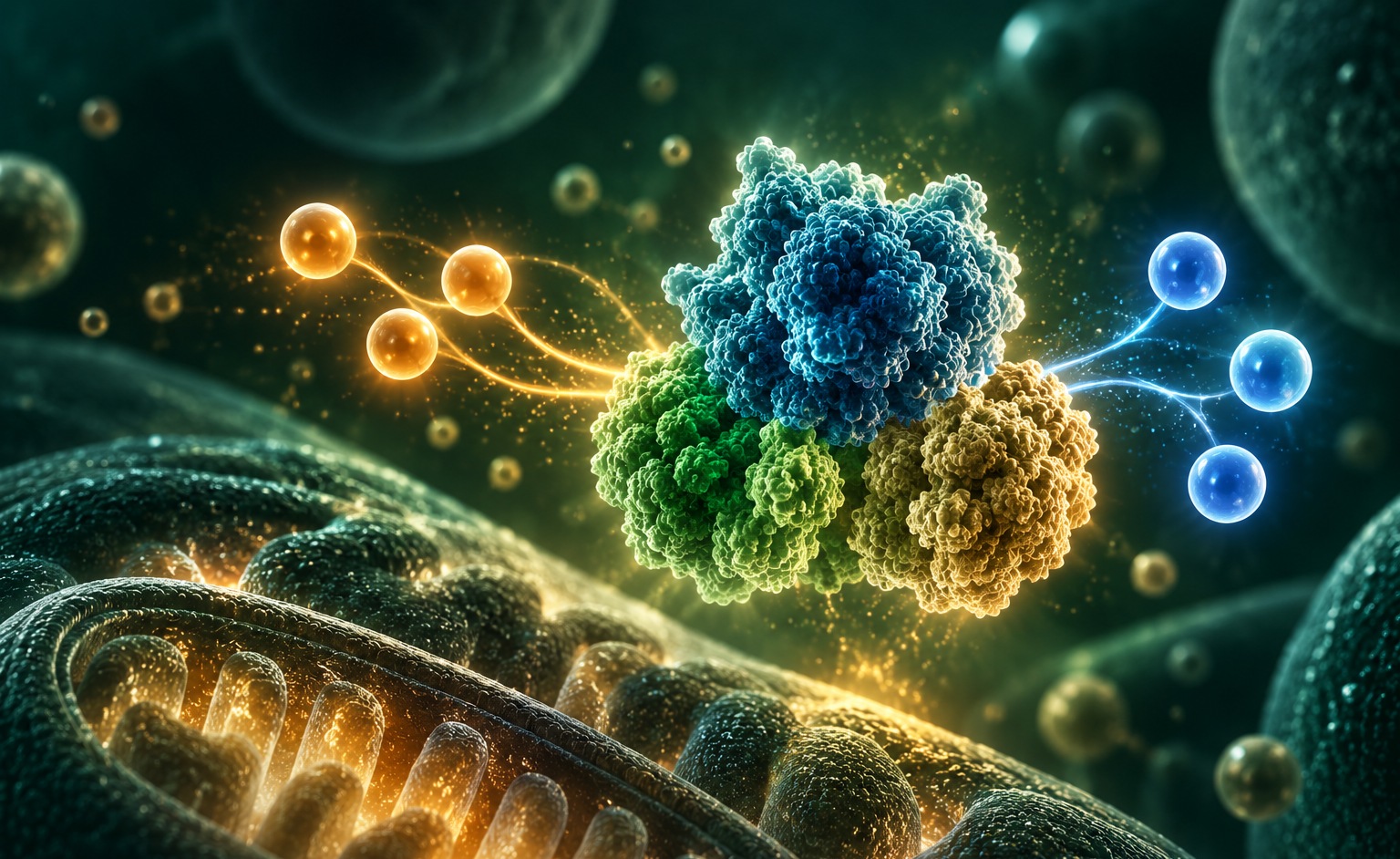
When cellular energy becomes limited, AMPK responds to help cells adapt to changing energy demand.
AMPK monitors cellular energy through changes in adenine nucleotide balance. As cellular energy becomes limited, AMP and ADP rise relative to ATP. Nucleotide binding at the AMPK γ-subunit helps shift the complex toward an activation-ready state.
Energy is relatively abundant.
Regulatory nucleotide signals increase relative to ATP.
AMP and ADP binding at regulatory sites on the γ-subunit helps AMPK recognize cellular energy stress and supports an activation-ready state.
AMPK activation can arise through two major signaling contexts. Energy stress changes nucleotide sensing at the γ-subunit and supports Thr172 phosphorylation, while elevated intracellular Ca²⁺ can engage CaMKK2. Both routes converge on the catalytic α-subunit.
relative to ATP
nucleotide sensing
major upstream kinase
AMP/ADP binding helps favor an activation-ready state and supports protection of Thr172 from dephosphorylation.
intracellular calcium
calmodulin context
CaMKKβ
This route can promote Thr172 phosphorylation without requiring a large shift in adenine nucleotide balance.
Energy state or calcium signaling provides the upstream context.
Upstream kinases act on Thr172 of the catalytic α-subunit.
Thr172 phosphorylation strongly increases AMPK catalytic activity.
Once activated, AMPK coordinates multiple downstream targets. Rather than controlling one pathway, it helps cells prioritize fuel use, restrain selected biosynthetic costs and support cellular maintenance.
Favor pathways that help meet ATP demand.
Reduce energy expenditure where appropriate.
Support autophagy and mitochondrial adaptation.
AMPK is studied across multiple tissues, where it helps cells adapt to energy demand and maintain cellular homeostasis.
Select a tissue to explore its AMPK research context.

This atlas summarizes broader AMPK biology across tissues. It does not mean Actiponin® has demonstrated every tissue-level effect shown here in human studies.
Mitochondria sit at the center of cellular energy adaptation. AMPK research connects energetic demand with substrate use, PGC-1α-associated programs and mitochondrial quality-control processes.

AMPK-related signaling responds to changing cellular energy requirements.
Research links AMPK with mitochondrial biogenesis-related adaptation.
Energy-sensing pathways intersect with mechanisms that remove damaged mitochondria.
AMPK connects cellular energy sensing with autophagy-related regulation through ULK1 and crosstalk with mTORC1, linking energetic stress to cellular recycling and quality control.
AMPK is a central node in nutrient-sensing and cellular-maintenance research relevant to healthy-aging biology. Its research context spans energy sensing, mitochondrial quality, autophagy, stress response and metabolic flexibility.
Interpret changing energy and nutrient availability in cells.
Support cellular recycling and quality control.
Adapt power production and organelle maintenance.
Coordinate energy status with growth-related signaling.
Help cells adapt to metabolic and energetic stress.
Adjust fuel use according to changing demand.
Actiponin® research provides a specific evidence-based connection to AMPK-related signaling. This direct evidence should be distinguished from the broader AMPK biology presented above.
AMPK activation, β-oxidation, glucose uptake and GLUT4-related observations in cultured L6 myotubes.
Heat-processed Gynostemma extract studied in cells and ob/ob mice with AMPK-related metabolic endpoints.
12-week randomized, double-blind, placebo-controlled clinical study of Actiponin®.
Review the mechanistic, preclinical, clinical and newer Actiponin® research documents in the evidence library.
EVIDENCE & DOCUMENTS